
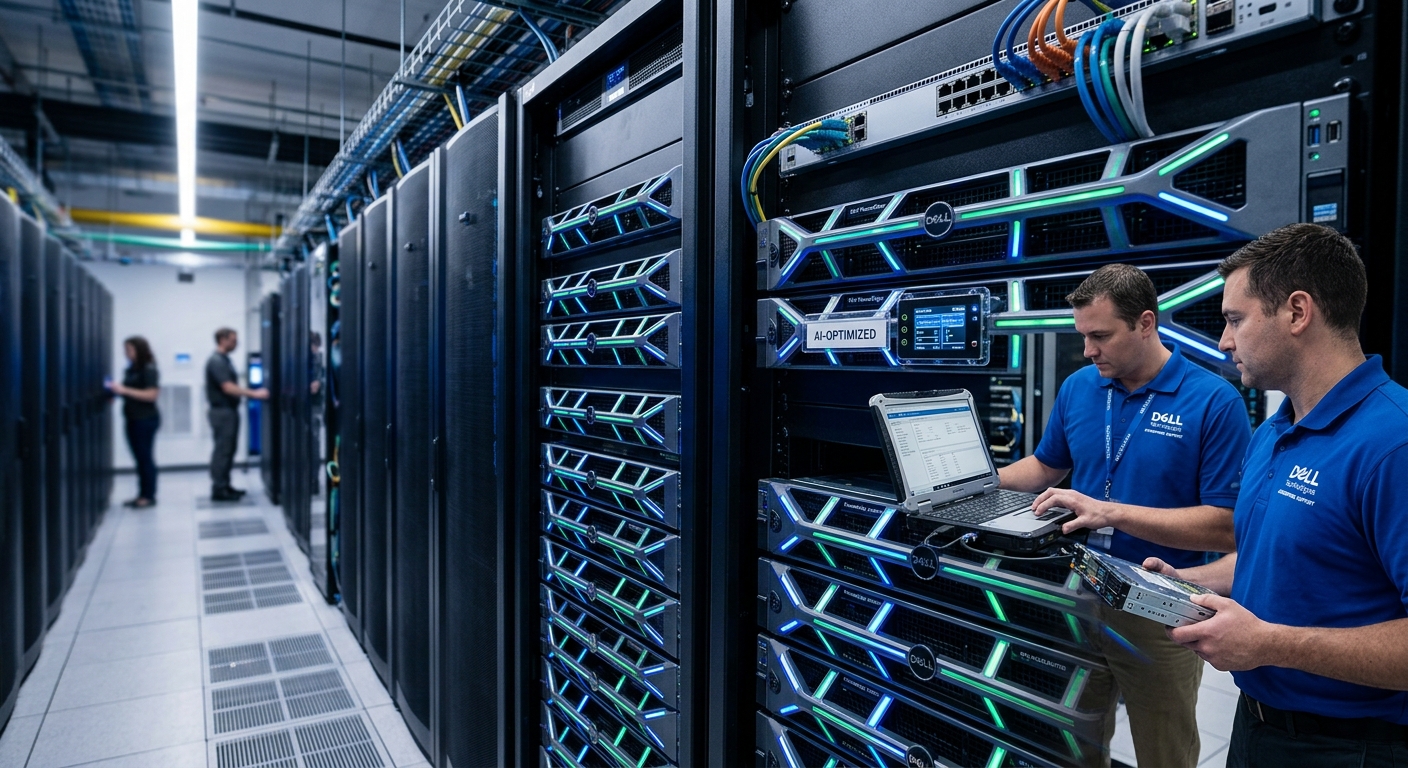
Michael Dell Hits Home Run with Blockbuster Q2 Earnings, but Supply Bottlenecks Shadow Outlook
CEO Michael Dell hit the ball out of the park with a home run earnings report.
Blockbuster Q2 Fiscal 2027 Performance
Dell Technologies delivered a blockbuster Q2 Fiscal 2027 financial release, significantly beating Wall Street consensus across top and bottom lines, fueled by surging enterprise demand for AI-optimized hardware. Key Quarterly Highlights (Q2 FY27)
Record Total Revenue: $47.0 billion, up 58% year-over-year (beating consensus estimates of ~$44.9B–$45.3B).
Record Earnings Per Share (EPS): Diluted GAAP EPS surged 273% YoY to $6.34. Non-GAAP diluted EPS reached $7.04 (up 203% YoY), easily outpacing consensus expectations of ~$4.95.
Record Operating Income: Reached $4.8 billion, representing a 225% YoY increase.
Segment Breakdown Infrastructure Solutions Group (ISG) & AI Drivers
AI-Optimized Hardware Drives Growth
AI-Optimized Server Momentum: Booked a record $60.9 billion in AI server orders and recognized a record $16.4 billion in AI server revenue during the quarter.
Backlog: Exited Q2 with a record $95.0 billion AI server backlog.
Traditional Infrastructure: Traditional servers and networking revenue rose 122% YoY, while storage revenue increased 26% YoY.
Client Solutions Group (CSG)
CSG Revenue: Reached $15.0 billion, up 20% YoY.
Commercial Client Segment: Record commercial revenue of $13.2 billion (up 22% YoY).
Consumer Segment: $1.8 billion, up 7% YoY.
Capital Allocation & Raised Guidance
Shareholder Returns: Returned a record $4.3 billion to shareholders in Q2 via dividends and share repurchases. Declared a cash dividend of $0.63 per common share payable on October 30.
Raised Full-Year Guidance: Dell raised its full-year FY27 revenue outlook by $25 billion to $192.0 billion (representing nearly 70% YoY growth). Full-year non-GAAP EPS guidance was revised upward to $25.50.
Could It Be Another Green Light for the NASDAQ and the Tech Sector AI Trade? Was There Anything Negative?
While the headline figures beat expectations, several underlying financial metrics and risk factors presented potential headwinds:
Supply Chain Challenges & Risks
Margin Compression in AI Hardware: Gross margins on AI-optimized servers face pressure due to high component costs for advanced GPUs, specialized cooling, and memory parts. Delivering complete server racks carries high top-line revenue but lower net profit margins compared to traditional enterprise software or storage.
Supply Chain Bottlenecks: Growth remains heavily constrained by component shortages across memory, high-performance CPUs, and optical networking gear. This limits how quickly Dell can convert its $95 billion AI backlog into recognized revenue.
Sluggish Consumer PC Demand: Within the Client Solutions Group (CSG), consumer revenue ($1.8 billion) grew at a modest pace compared to the enterprise segment, reflecting a slower consumer PC upgrade cycle.
Geopolitical & Tariff Risks: Broader macro concerns, including proposed tariffs on hardware containing imported semiconductors, continue to create uncertainty around future hardware pricing and end-market demand.
Supply vs. Demand: The Central Question for Tech Investors
Once again, it is the same narrative in the tech sector: supply and demand are out of balance. As the saying goes, supply and demand are often seen as the fundamental basis of economics.
With any great industrial build out driven by intense demand, higher demand inevitably brings higher prices—whether for finished hardware or the underlying commodities behind the build out, such as copper.
The presence of immense demand acts as a clear green light, but investors hold extremely high expectations. If supply cannot keep pace, can companies deliver the required return on investment (ROI), or will timelines be pushed back?
It will be fascinating to see how NASDAQ futures play out as traders, investors, and the wider market decide where the true weight lies: on supply constraints or demand momentum.