
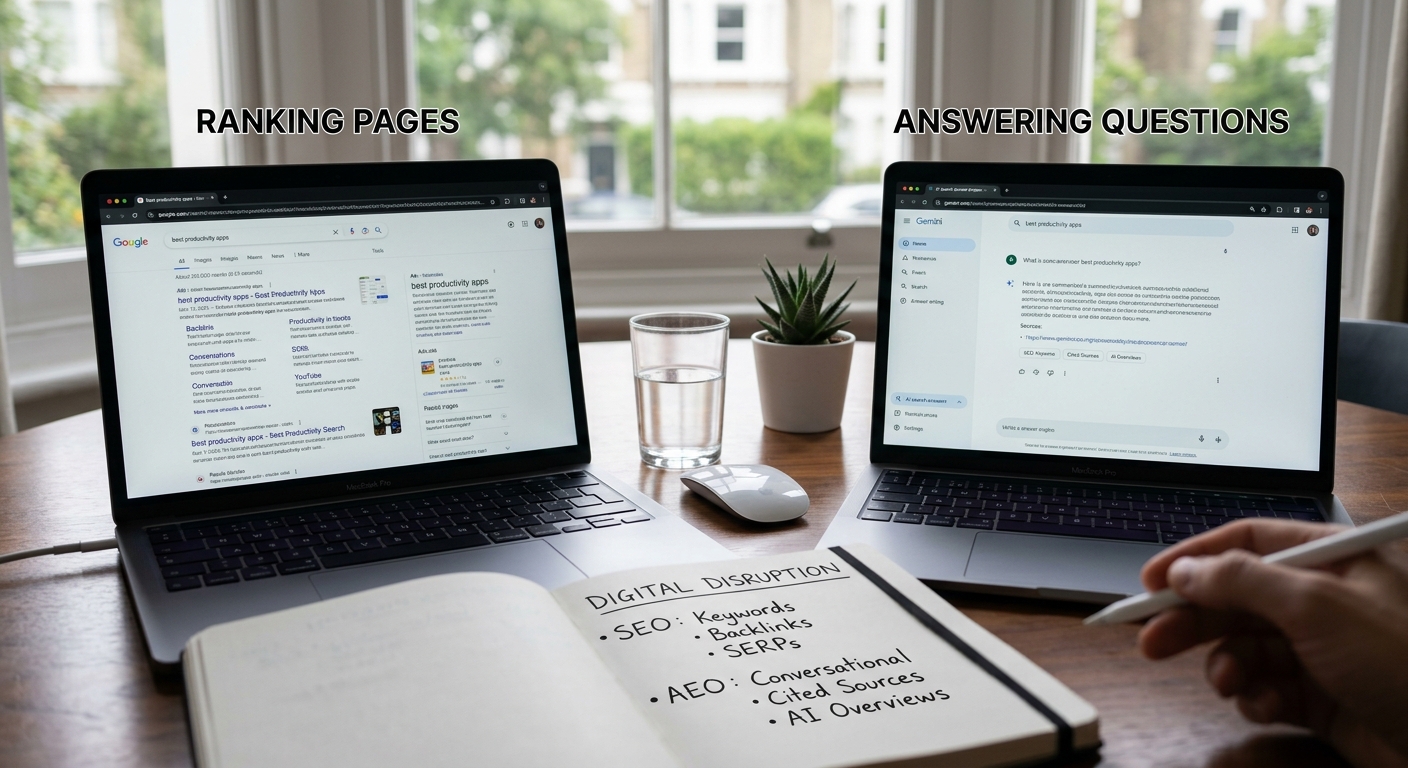
SEO vs. AEO: The Shift From Ranking Pages to Answering Questions and the Erosion of the Ad-Supported Web
People would not have really noticed, but Google Search has had a massive percentage of its usage taken away by chatbots since the rise of ChatGPT in 2023 from OpenAI, and then many chatbots followed. It has massively changed the landscape of the internet and most online businesses. If they don't sell a product like e-commerce, they rely mainly on two kinds of business models: ad revenue or a subscription model.
With chatbots taking away some of that ad revenue—because instead of a human searching the web and trolling through data themselves to find an answer from a website and, at the same time, stumbling across ads while being web traffic—we are now in the era of humanity where we ask a chatbot, Large Language Model (LLM), that question. It trolls the internet in fractions of a second, and bam, there is your answer.
The ad revenue model has not just lost some of its revenue, but a massive percentage. That has given space for the rise of platforms like TollBit, where just like a toll booth on a motorway or highway, AI bots that scrape data from your website now pay a fee for that pleasure. Why should they scrape for free?
The big AI models from the big tech companies tend not to pay this, nor do people tend to charge them on the hope their website is cited in the answer. That is where, after the chatbot gives you your answer, it will cite where it got that data from—often with a clickable link straight to your website—which, for website owners, is very attractive. Hence, why they would not charge a toll.
Outside of that, there are many, many other third-party AI chatbot LLMs that are either training their models or answering questions to users. For scraping the data from your site, it is only cents, but at mass scale, it can be lucrative. However, it depends on factors such as:
How much data your site has to scrape,
How niche that data is, and
How much demand there is for that question to be asked.
For example, if your website was one of the only sites in the world to have information on a certain thing, and then all of a sudden that question became a massive search in chatbots, that could be a goldmine and a good business quarter for your company—maybe until the rest of the world caught up with that question and put data out there on that matter.
You may have noticed how YouTube adverts have become longer, more frequent, and there are more of them. This could be Alphabet, the parent company of Google, making up for losses on Google Ads on Google Search and filling that revenue up so it does not reflect in their quarterly earnings reports or reflect in the stock price, even though they would have revenue coming in from Google Gemini chatbot subscriptions.
Data Centers: The New Filing Cabinets
It was once said in the 2010s, when the Apple App Store and rival Android app stores came about, that it was the end of websites. But studies have shown that websites have grown alongside them. So, maybe a similar dynamic will be at play here. The Infrastructure Shift: From Filing Cabinets to Data Centers
Years ago, many great minds said that in the future, data will be the new gold. Now, we are very much moving into that era of humanity with the data center becoming a household name; before AI, no one ever spoke about the data center.
With that, it is important to note that in people's own lifetimes, they have seen things go from a pen-and-paper economy to a data center, which is a big jump. Transitioning from pen and paper to a typewriter, and data being kept in a filing cabinet with a human who went and pulled from a filing cabinet, to basically an API that does that same pull. The data center has become the new filing cabinet: from typewriter and filing cabinet, to desktop computer in the office and hard drive, to later, cloud computing.
In this transition we have just discussed has come massive gains in productivity throughout all sectors of the economy. But even more than that, it has created great speculation for the next leg of the technology revolution.
STOCK MARKET VALUATIONS THROUGH TECH...
Stock market valuations since the '90s have reflected that, and that is why finance and technology are so intertwined. We need greater technology to get greater productivity gains, and we need people to invest in that future, with technology being the most speculative sector in the economy. Really, if you stripped out tech from the stock markets, the valuations would not be very high. Most of the world's capitalization in technology in stock markets is concentrated in the US mainly, apart from ASML in Europe and then some bits in Asia. For the US economy, for example, if you took that away, what was left before it? McDonald's Corporation, AT&T, Procter & Gamble, and oil companies? Most of the world's wealth is herded into the speculation of technology. Technical Framework: SEO vs. AEO
SEO vs. AEO: Core Optimisation Shifts
The search landscape is undergoing a fundamental shift. For two decades, Search Engine Optimization (SEO) focused on ranking web pages on traditional Search Engine Results Pages (SERPs) to drive organic website traffic. Today, the rise of Large Language Models, AI assistants, and smart search features (such as ChatGPT, Perplexity, Gemini, and Google AI Overviews) has introduced Answer Engine Optimization (AEO). Core Summary
Target of Optimization: Traditional SEO optimizes full web pages to win high-ranking clickable links on search results pages. AEO optimizes specific blocks of factual information, structured data, and answers so AI engines can extract, cite, and surface them directly inside AI-generated responses.
Shift in User Behavior: SEO targets broader keyword search terms (e.g., "best CRM software"). AEO caters to natural-language, question-based conversational queries (e.g., "What is the most affordable CRM for a small business with five employees?").
Content Structure & Formatting: SEO relies on comprehensive, long-form content, internal links, and domain authority to rank. AEO relies on concise, front-loaded answers, clear bullet points, definition blocks, schema markup, and verifiable facts that AI models can digest and cite.
Success Metrics: Success in SEO is measured by search engine rankings, click-through rates (CTR), and organic site visits. Success in AEO centers on "zero-click" visibility, AI overview inclusions, citation share, and brand mentions across conversational AI surfaces.
Symbiotic Evolution: AEO is not a replacement for SEO, but an evolution. Traditional technical SEO and domain authority provide the foundational trust that AI models need to select a website as a credible source for its answers.
Human Creation's Future in AEO
The Human Value Paradox and the Future of Creation
What people need to realize is that the only true value is in original human creation, as AI (artificial intelligence) compute, chatbot Large Language Models do not create—they just regurgitate data and information that is already out there.
The scary part of that is because ad revenue is being replaced by AEO (Answer Engine Optimization), it leaves less financial incentive for humans to create original, human-created content, and possibly humans become less creative with it. AI chatbots are great now as they have all the data of the present and even the past, but what about in a future with less and less human-created, generated content? Then how does the AI continue to be great?
And is this paradox the peak of information?