an argument against ray dalio theory (dealing with the changing world order) The Limits of the "Big Cycle": Why Ray Dalio’s Empire Theory Misses Modern Financial Reality Ray Dalio, Bridgewater, and "The Big Cycle"
Ray Dalio & Bridgewater: Ray Dalio is the billionaire founder of Bridgewater Associates, the world’s largest hedge fund known for its macroeconomic forecasting and culture of radical transparency.
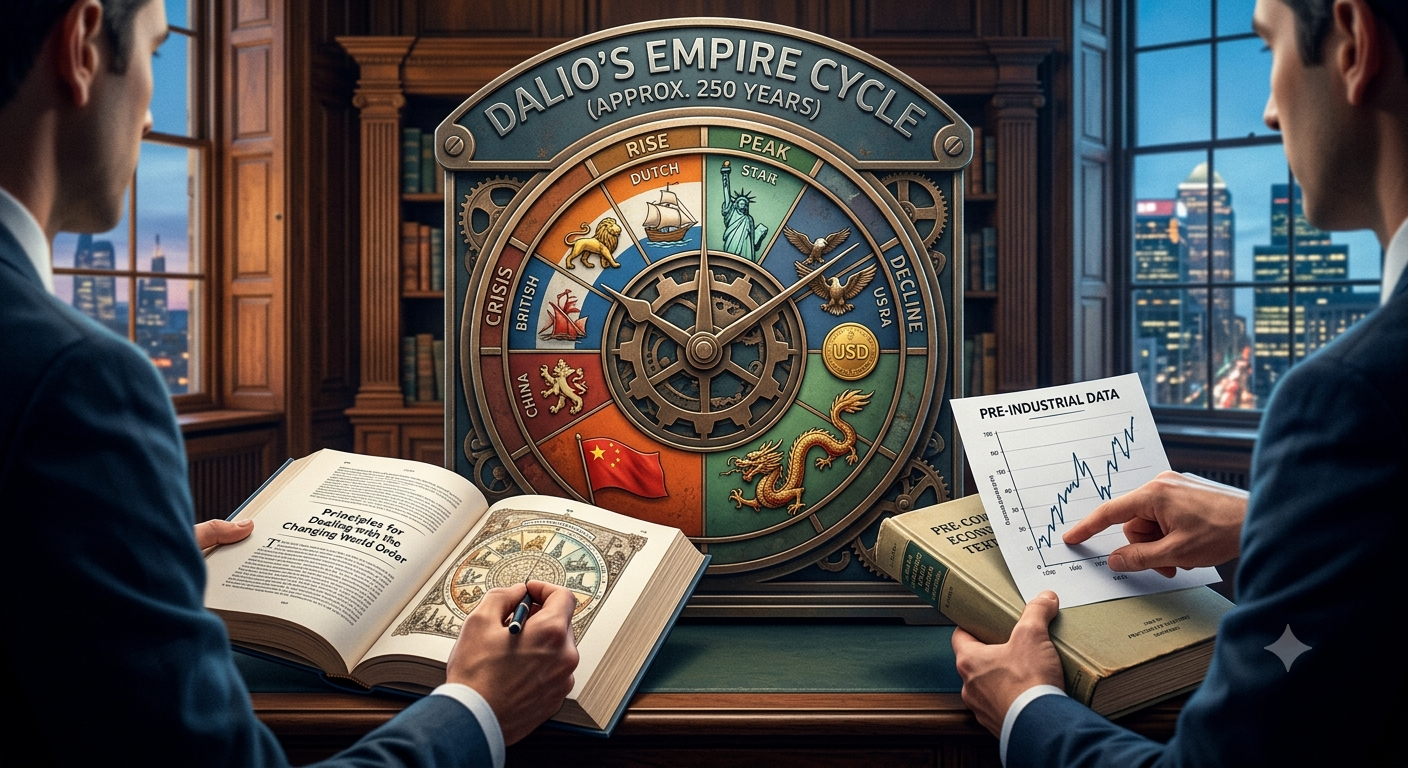
The Book: In his 2021 bestseller, Principles for Dealing with the Changing World Order, Dalio analyzes 500 years of financial history to study why dominant powers inevitably rise and fall.
The Theory: Dalio argues that empires follow a predictable ~250-year "Big Cycle" driven by debt, internal wealth disparities/political division, and external military or economic rivalries. Once an empire takes on unsustainable debt, prints excess money, and loses its competitive edge, it passes the torch—and reserve currency status—to a rising superpower.
The Viral Video: Popularized by his viral 45-minute animated YouTube video (Principles for Dealing with the Changing World Order), Dalio highlights the U.S. reaching the late, volatile stages of its 250-year shelf life as China emerges as the next global leader.
Progress, Trust, and the Unique Structure of the American Hegemony
The Dalio from Bridgewater Securities is definitely right when he says history repeats itself, and more often than not, it does. But here is an example of how it doesn't, and why civilized progression might outweigh his theory.
Traditionally, a monarch or totalitarian kingdom ruled as an empire, which then transitioned into the national, democratic, capitalistic state. Ray Dalio speaks about prior empires, specifically the British Empire and the Dutch Empire. I will raise some key differences between them and the United States of America.
The British Empire and the Dutch Empire were, first of all, single-ethnic-group empires led by Caucasian Europeans who colonized—the British Empire doing this to an even greater extent by colonizing much of the world. Because of this, they did not have the greatest perception of global relations or human rights. They were both non-liberal societies without a great deal of freedom of speech.
The United States of America, on the other hand, is a multi-ethnic, multicultural, and modern free liberal society. It has a much better perspective on global international relations and human rights than previous empires led by dictation over their own people.
Because the United States is part of this free, liberal world, it attracts a global talent pool—a major factor to take into account. The U.S. attracts the world's best talents and minds to study at its universities and work at its mega-cap corporations, which are democratically run companies rather than state-backed entities. These reasons build trust and reputability in U.S. finance—whether in its currency, the U.S. Dollar (the world's reserve currency and trusted means of exchange for global trade), or the U.S. stock market, with the S&P 500 acting as the world's benchmark for investing.
Remember that finance is built on trust and reputability, not just raw power. China, on the other hand, is a single-ethnic-group society (Han Chinese) and is not a free, liberal society. Its strict environment does not attract the world's greatest minds in the same way. Dalio may be right that history simply repeats itself and tribalism plays out, or things could develop as humanity becomes more civilized, signaling that the days of the traditional global empire are over. China’s Deep History and the Dual-Dependency Economy
We also need to note that some of the great economic achievements China has had in recent years are treated as if they are brand new, but I will give two great examples showing they are not.
We look at their marvels in engineering in recent years—building skyscrapers, massive bridges, and more—but an amazing engineering masterpiece from their history is the Great Wall of China. We also look at manufacturing as a new phenomenon for them, but we quickly forget about bone china plates and teapots being in every home just a few generations ago. Today, more driveways in Europe may have BYD Chinese electric cars than Tesla's Western-designed and built electric vehicles.
If we look at China's manufacturing power transferring into military might as a reason for global dominance, let's not forget that China in history was already a major military superpower long before the invention of firearms in warfare. Furthermore, when it comes to their manufacturing might, they remain heavily reliant on the U.S. and Europe to buy their products—most notably the Apple iPhone. Rather than a pure takeover, it is a dual-dependency relationship. Currency Alternatives and the Case for Global Collaboration
Talk of the end of the dollar as the world's reserve currency has been a major topic in recent years, fueled by the 2008 financial crisis brought on by U.S. mortgage defaults, as well as U.S. sanctions, which are not always popular. Recently, the U.S. stated that if Iran agrees to certain terms regarding nuclear weapons, they will lift sanctions, which reinforces the credibility and authority of the U.S. dollar.
Consider these insightful words from Larry Summers, former U.S. Treasury Secretary and former Harvard President, regarding global currencies and reserve alternatives:
"Europe is a museum, Japan is a nursing home, China is a jail, and Bitcoin is an experiment."
Summers brought up this line on multiple occasions—notably at the Morningstar Investment Conference in April 2023—to argue why the U.S. dollar remains the dominant global reserve currency despite its flaws, simply because all competing alternatives face fundamental structural issues.
Often we hear doomsday prophets who hoard tins of food and survival supplies, remaining bullish on precious metals like gold and silver, or proposing a decentralized currency like Bitcoin as the ultimate answer. If we were to choose gold without an interest rate system as some propose, we would be moving backward as a civilization. Gold evolved into gold coins, which eventually led to banknotes, and ultimately to the progression of a digital financial system.
The world requires order. Whether Dalio is correct and the Chinese Yuan becomes the world's reserve currency, who knows? Another possible scenario could be the U.S. dollar merging with the Euro and the British Pound into a single global currency—creating a far stronger economy, currency, and military than China.
It was not long ago, before the inception of the Euro, that each European nation had its own currency, the strongest being the German Deutsche Mark (the successor to the Reichsmark, Nazi Germany's WWII-era currency). A national currency has a massive connection to national identity, and whether citizens vote to keep their national currency becomes a political question of nationalism versus globalism.
One cannot deny we have moved closer to a globalized world with less nationalistic rhetoric and more multicultural integration. Was it the dark history of colonization that ultimately paved the way for multiculturalism?
Militarily, through organizations like the UN since World War II, humans frequently talk about World War III. But what if it never comes? What if nation-against-nation tribalism is behind us, and we move forward as a species into a more collaborative world? Ultimately, what separates us from tribe-against-tribe conflict is collaboration.