
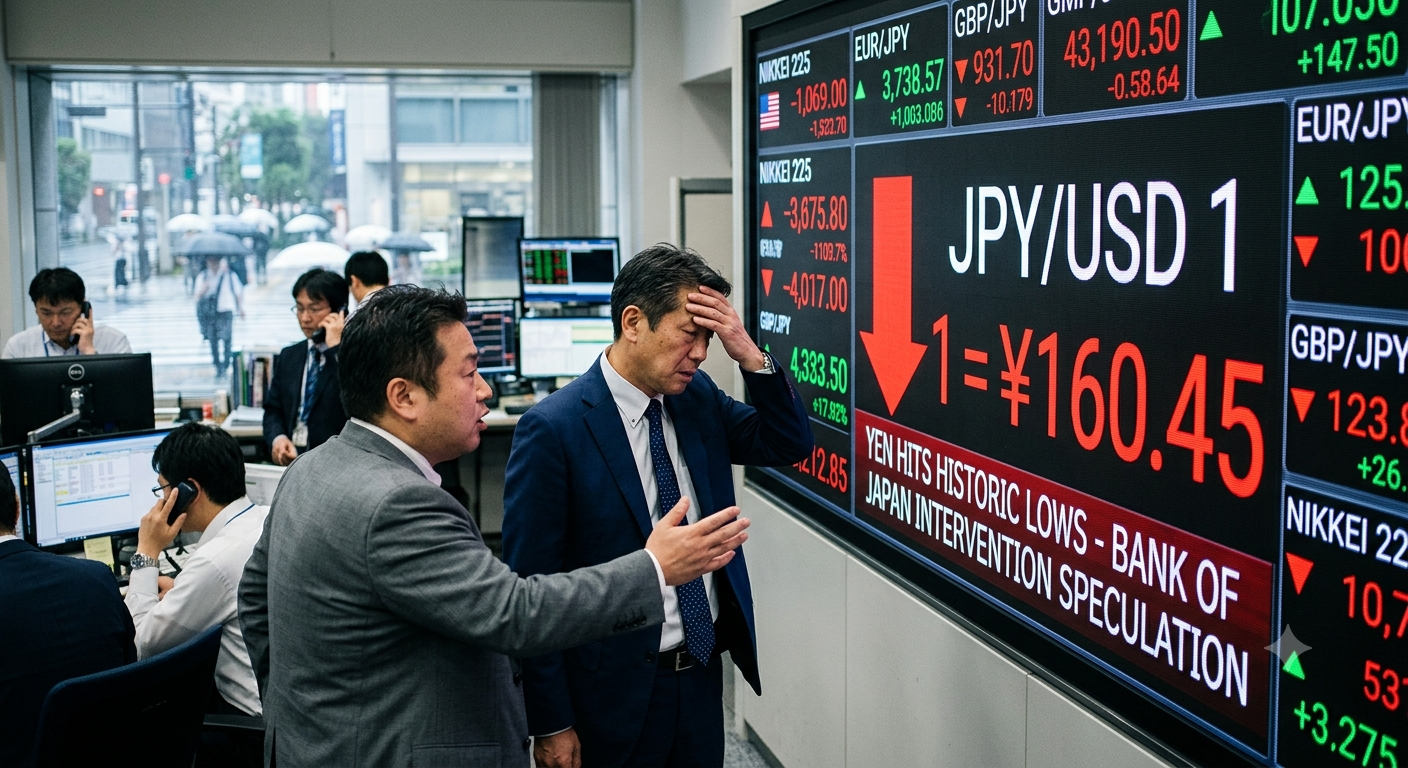
The Japanese Yen (USD/JPY) Situation Key Drivers & Recent Events
Historic Weakness: The Yen recently tumbled to a 40-year low near ¥164 to the US Dollar—levels not seen since 1986. This was driven by wide interest rate differentials (the yen carry trade), high import costs, and expansionary fiscal policy concerns.
Rare Coordinated U.S.–Japan Intervention: On late Friday, July 31 (confirmed Monday, August 3), Japan’s Ministry of Finance and the U.S. Treasury launched a rare joint yen-buying intervention. This marks the first joint U.S.–Japan yen-buying intervention since the 1998 Asian financial crisis.
Market Impact: Official estimates suggest spent totals around $50B–$60B in combined operations. The move sparked a sharp repricing, sending USD/JPY down from ¥163.90 to around ¥155–¥157.
Ad · Medium Rectangle 300×250
Macro Dynamics & Policy Dilemma
Imported Inflation Risk: A weak Yen drives up import costs (food, energy, raw materials), keeping Japan's core CPI inflation above the BOJ's 2% target (projected ~2.5% for 2026).
Rate Normalization: To curb upside inflation risks, the BOJ has shifted away from ultra-loose policy, raising its benchmark rate to 1.0%—its highest level since 1995—with markets pricing in further hikes.
The Policy Dilemma: Keeping rates low widens the U.S.–Japan yield gap (weakening the Yen further), while raising rates too quickly risks dampening domestic economic growth.
Outlook: The Yen Carry Trade
Japan has been renowned for deflation for many years. Recent inflation, along with rumors of the Bank of Japan (BOJ) hiking interest rates from their famous low, has brought a lot of attention. As famously the BOJ has been hawkish, even hiking rates could possibly be an unwind of the Japanese carry trade.
The Japanese carry trade is where, in the West, they lend low rates in Tokyo and sit it in assets primarily in the US like bonds, profiting on the difference. When the BOJ hikes, it unwinds this trade. It will be something for global finance to keep its eyes on in the coming weeks.