
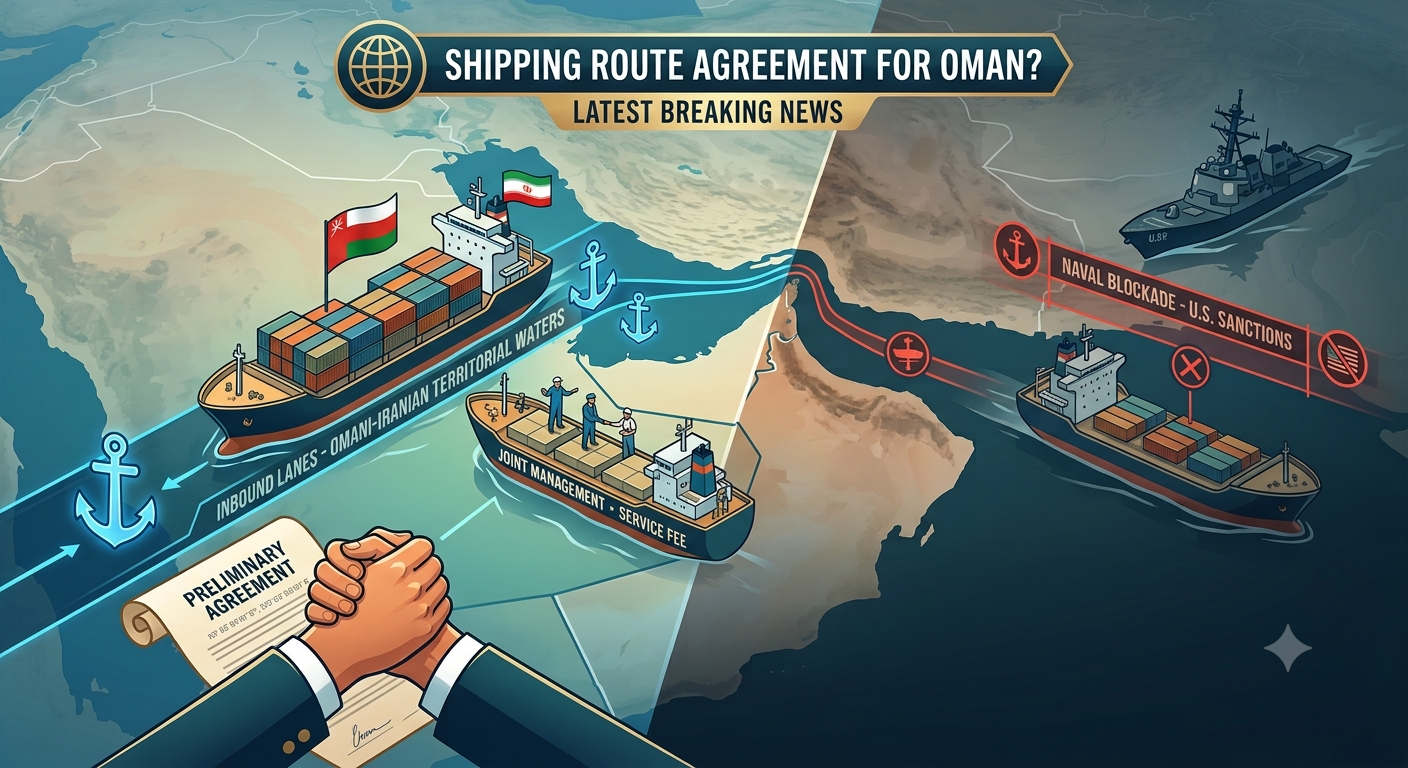
Maritime Progress in the Middle East: Iran and Oman Reach Preliminary Agreement on Strait of Hormuz Corridor
Iran and Oman have reached a preliminary agreement on a designated maritime shipping corridor through the strategic Strait of Hormuz. Key Details
Agreed Coordinates: Officials from Tehran and Muscat confirmed that technical teams have mapped out specific geographical coordinates for inbound and outbound shipping lanes passing through Omani and Iranian territorial waters.
Proposed Management Structure: Under the emerging framework, inbound vessels entering the Persian Gulf would travel through a channel overseen by Iran, while outbound traffic would utilize a lane closer to Oman. The arrangement includes plans for a shared "service fee" to cover security, maritime staffing, and environmental protection.
Context & Hurdles: The agreement aims to partially restore commercial traffic in a waterway that handles roughly 20% of the world's oil supply following months of disruption and naval blockades in the region.
Remaining Conditions: Iranian officials cautioned that a formal reopening depends on the U.S. lifting its naval blockade on Iranian ports. A joint Oman-Iran statement is in final review pending remaining diplomatic negotiations.
Analysis: Market Impact vs. Geopolitics
This agreement is great for world trade and the price of oil, and then global inflation. Hopefully, it is not just a news headline to bring down the oil futures price.
Often, when the U.S. has claimed an agreement on anything, the IRGC (Islamic Revolutionary Guard Corps) has almost always claimed that on their side no talks have been had or agreement been discussed.
One thing is for certain: conflicts and wars can't last forever, and at some point, the Strait of Hormuz must open for global trade. One thing the West is frightened of is at the cost of Iran charging a toll on the shipping route, which from the U.S. side could be seen as a loss.