
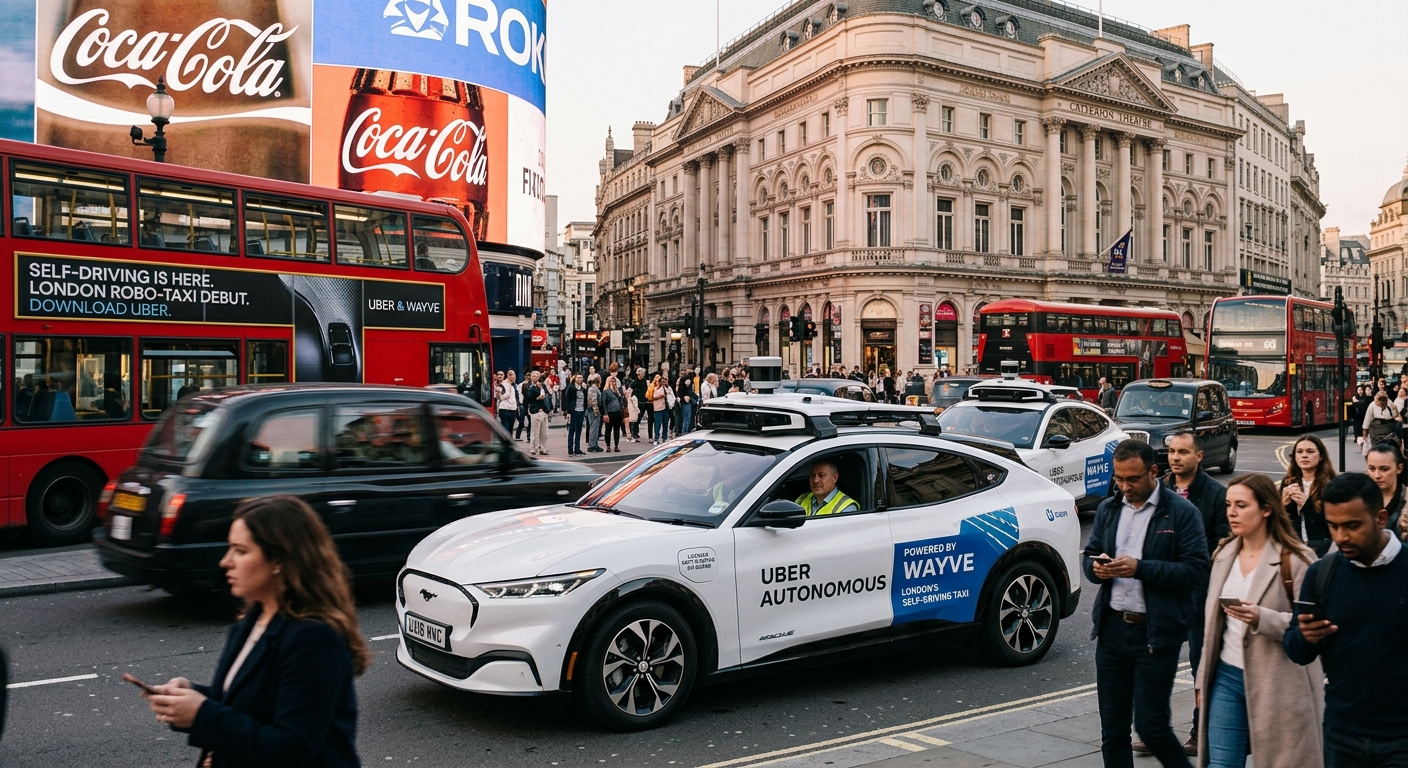
Uber & Wayve Bring First Self-Driving Fleet to UK Capital, Bypassing Tesla
Robotaxi debuts in London and it is not a TESLA Robotaxi .
On Thursday, September 3, 2026, London officially launched its first self-driving taxi service via a partnership between Uber and UK autonomous driving startup Wayve. The commercial deployment marks the first time autonomous passenger rides have been integrated into a European capital. Launch Details & Operational Setup
London Robotaxi Launch & Operations
The Fleet: The initial deployment consists of 15 fully electric Ford Mustang Mach-E vehicles fitted with Wayve's AI Driver software and sensor suite.
Supervised Autonomous Driving: Per UK regulatory requirements, each vehicle operates with a Transport for London (TfL) licensed safety driver in the front seat, who can step in if required.
Uber Integration: London riders requesting standard UberX, Uber Electric, or Uber Comfort trips can be randomly matched with a Wayve autonomous vehicle at no additional cost, with the option to accept or decline the ride before arrival. Over 140,000 users have already opted in through the app.
Technology Model: Unlike US rivals such as Waymo that rely heavily on dense HD pre-mapping, Wayve’s platform utilizes an AI machine-learning model designed to generalize and navigate complex, unpredictable urban environments.
Strategic Context & Global Race
Strategic Edge in European Market
First Mover Advantage: The rollout gives Uber and Wayve a head start in Europe, where driverless commercial services have lagged behind the US and China.
Upcoming Competition: Other key players, including Alphabet’s Waymo and China’s Baidu, are actively conducting road tests in London ahead of planned UK commercial rollouts.
Path to Fully Driverless: Wayve plans to transition to scalable manufacturer-produced vehicles (such as the Nissan Leaf) and validate safety metrics to secure regulatory approval for fully driverless operations (without safety drivers).
European Infrastructure Challenges & The Future of Labor
London is late to the party off international citys to get the robotaxi . A lot of US citys already have the autonomous self driving taxis but some off the roads in London and throughout Europe are thousands off years old and even date back to the Romans and propose much more challenges for self driving ai technology with winding roads rather than the straight in the US . and with the UK and EU having much stricter in the regulatory sense that has its challenges to such innovation , another thought is the old London cabbie and taxi drivers is it a dying profession to be replaced by ai and is this just the start off driving jobs to be replaced by artificial intelligence technologies .