
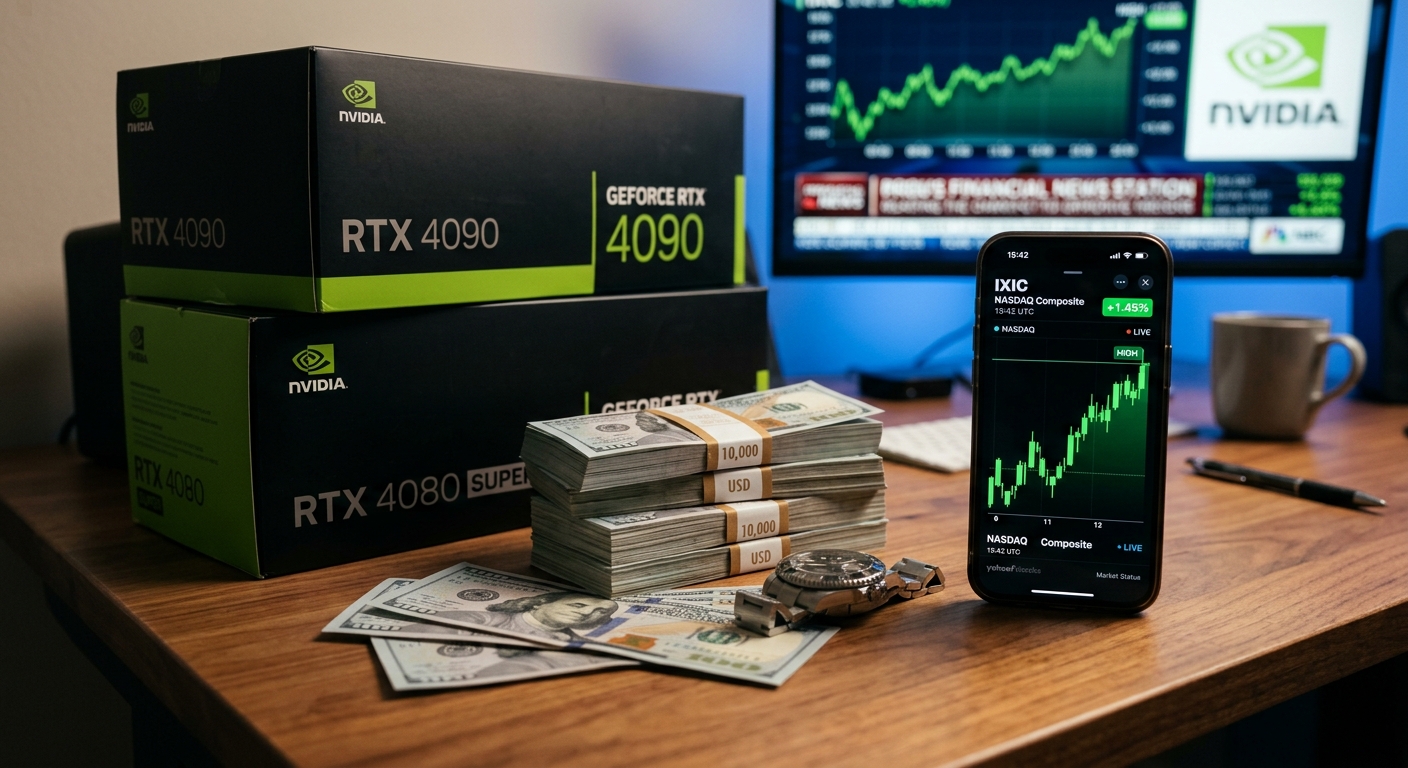
The history of AI compute from a $1,000 dual-GPU hack in a university lab to a $5+ trillion corporate empire and global rack-scale infrastructure race. Linking the humble origins of the 2012 ImageNet breakthrough directly to modern hardware complexity (the 72-GPU Blackwell rack) highlights the dramatic scale of the current AI industrial revolution and a question off stock market valuations .
From a $1,000 University Experiment to $5 Trillion: The Unlikely Origin of Nvidia’s AI Dominance
Nvidia's Humble AI Beginnings
Not many people are aware, but all an Nvidia Blackwell is is 72 GPUs on a rack with CPUs—nothing much more. And with Nvidia's share price rising 430%-ish since 2023, a whole ecosystem of share prices in stock markets has raised with it—initially in tech, now branching out into other sectors of the economy by increasing the productivity of companies in retail, manufacturing, and many more other sectors, and even creating a new cold war AI race between the US (United States of America) and China. The NASDAQ US TECH 100 has absolutely rocketed in value since the build-out of this new infrastructure and industrial revolution, with investors and traders making millions. The $1,000 "Big Bang" of AI
Also, not many people know this, but in the 2012 ImageNet moment—the exact catalyst Nvidia CEO Jensen Huang frequently cites as the "Big Bang of AI"—the whole new economy we are entering into with AI agents replacing humans in the workplace, the story started out with two AI GPU graphics cards (graphics processing units) worth $500 each, put together with a CPU (central processing unit). It started out with two individuals, not a big tech company. The Story
The Researchers: The "two kids" were Russian-born graduate students Alex Krizhevsky and Ilya Sutskever (who later co-founded OpenAI), working under computer science pioneer Geoffrey Hinton at the University of Toronto.
The Breakthrough: Up until 2012, traditional AI neural networks were trained using standard computer processors (CPUs), which were too slow for massive datasets. Realizing they needed massive parallel processing power, Alex Krizhevsky bought two off-the-shelf consumer gaming graphics cards—Nvidia GeForce GTX 580s—for roughly $500 each.
The Twin GPU Hack: Because a single GPU didn't have enough memory to store the entire deep neural network, Krizhevsky custom-programmed CUDA (Nvidia's parallel computing language) to run the neural network across two GPUs combined with a CPU. The model split the cross-layer processing mathematically across both graphics cards simultaneously.
The ImageNet Stunner: They entered their AI model, named AlexNet, into the 2012 ImageNet challenge—a global image recognition competition with 1.2 million images. AlexNet destroyed the competition, achieving a top-5 error rate of 15.3% compared to the runner-up's 26.2% (which relied on traditional CPU methods).
The Nvidia Impact
When Jensen Huang saw that two university students crushed decades of computer vision research using two cheap consumer gaming GPUs, he immediately pivoted Nvidia's entire corporate strategy. Recognizing that GPUs were the ideal engine for deep learning, Jensen directed Nvidia to invest billions into optimizing their chips and software for AI—setting up Nvidia's modern dominance. From Underground Gaming Roots to a $5 Trillion Empire
It's amazing to think the whole new economy we are moving into is built from gaming graphics, and that was the answer to mankind's future technical innovation. Nvidia quietly worked in the shadows of the gaming industry and pioneered the revolution of high-end graphics as a mainly unheard-of company—only spoken about in dingy, dark corners by a few gaming geeks—to the world's most valuable company with a market cap that overtook Apple, topped $5 trillion, and pretty much took over the world. Yet the scary part is: CEO of Nvidia, Jensen Huang, is still not a household name and is mainly still unheard of by the mainstream. Will it take until they have lost their jobs to truly find out who he is? The Blackwell Machine: Compute at Rack Scale
The Blackwell is basically 72 of these graphics cards with a price tag of three to six million dollars.
Blackwell: Rack-Scale AI Powerhouse
The flagship implementation of Nvidia's Blackwell architecture—specifically the GB200 NVL72—is designed as a single rack containing 72 Blackwell GPUs connected so closely that the entire rack acts like one massive GPU.
- 72 GPUs and 36 CPUs Built into Compute Trays
Instead of selling standalone cards that plug into standard PCIe slots, Nvidia builds specialized compute "trays".
A single rack holds 18 compute trays.
Each compute tray houses 2 Grace CPUs and 4 Blackwell GPUs (configured as two "GB200 Superchips").
Across all 18 trays, you get 36 CPUs and 72 GPUs in one single cabinet.
- The NVLink "Backplane": Making 72 GPUs Act as One
When training or running giant trillion-parameter AI models, the biggest bottleneck is sending data between separate GPUs. In older generations, connecting GPUs across different boxes required standard network cables (like InfiniBand or Ethernet), which slows things down.
In the NVL72 rack, all 72 GPUs are wired together through a massive copper backplane running down the back of the rack using 5th-generation NVLink switches.
This creates a shared 130 Terabytes per second (TB/s) bidirectional bandwidth domain.
Every GPU can talk to any of the other 71 GPUs at full speed simultaneously without network lag, effectively treating the entire 72-GPU rack as one gigantic GPU with 13.4 TB of pooled high-bandwidth memory.
- Full Direct Liquid Cooling
Because 72 ultra-high-power GPUs and 36 CPUs are packed into a standard 19-inch server rack, traditional air cooling fans are completely impossible.
The entire rack draws up to 120 kW to 135+ kW of power.
Nvidia designed the rack for direct-to-chip liquid cooling, pumping cold liquid straight across cold plates sitting on top of the GPUs, CPUs, and NVLink switch chips.
Summary
Instead of thinking of Blackwell as an individual graphics card you plug into a PC, the GB200 NVL72 is a rack-scale computer where the "building block" isn't a single card—it is 18 trays holding 72 GPUs, bound together by copper backplane switches into a single liquid-cooled AI powerhouse. Macro Valuation Questions
AI Valuations and Future Economy
The Blackwell models are thought of as being more for powering chatbot Large Language Models (LLMs), and the new Vera Rubin is thought of as powering the new AI agent economy. But with the original AI "Big Bang" moment being just two $500 GPU graphics cards with a CPU, it makes you wonder about the valuation of the economy and stock indexes such as the NASDAQ.