

On this Fed day, we have big tech NQ futures advancing with a Fed decision and speech only hours away. It looks like up to now the story is playing out this week where the market ignores the macroeconomic reality and favors stock market bullishness. Remember, these are great companies, and in enterprise and technology, they will change the world and make the economy more productive, and investors will be rewarded over time for that.
But remember, retail trading stock pickers the majority of the time don’t understand the macroeconomics at play in the background behind the excitement. Anybody that wants to be a participant needs to buy in, but at such high valuations is questionable. They say it’s not about timing, it’s about time in markets, but I’m sure some traders would disagree with that old saying pushed by longer-term investors that don’t appreciate the macro trend or treat short-term volatility as noise.
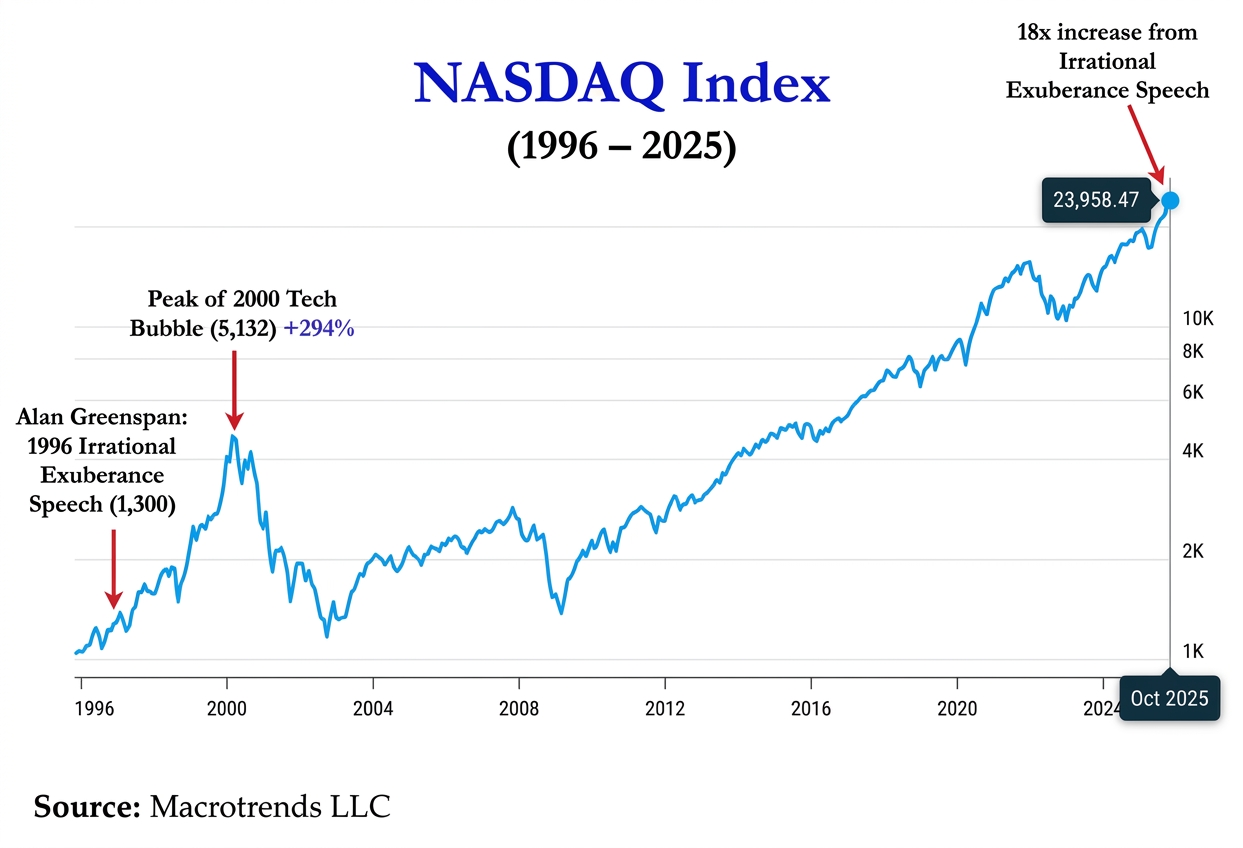
Federal Reserve Chairman Alan Greenspan coined the phrase "irrational exuberance" on December 5, 1996, during a speech at the American Enterprise Institute in Washington, D.C. At that price, the NASDAQ was at $1,300; today, the US tech stock index trades at around $30,000.
The London morning has been defined by a sharp escalation in energy market volatility and a persistent climb in US Treasury yields, which are now exerting significant pressure on the broader risk complex. As the 10-year yield scrapes the 4.993% mark, the gravitational pull of the 5% psychological handle is draining momentum from non-yielding assets like gold and silver while simultaneously providing a floor for the US Dollar. This upward trajectory in rates is forcing a revaluation of equity multiples, particularly within the interest-rate-sensitive components of the FTSE 100 and DAX, both of which have seen their early gains evaporate as the session progresses.
Forex — Dollar Resilience Squeezes Euro and Sterling
The US Dollar Index has carved out a steady advance to 102.370 this morning, benefitting from the widening yield differential as US debt remains more attractive than its G7 peers. This strength is most visible in EUR/USD, which has retreated 0.37% to trade at 1.11320. The pair is now dangerously close to its 60-day swing low of 1.11141; a sustained breach of this level would effectively clear the path for a test of the 52-week floor at 1.11140. Given that the current price sits well beneath the 20, 50, and 200-day moving averages—the latter of which resides at 1.15690—the technical structure remains heavily weighted to the downside, with sellers maintaining control as long as the 1.12170 (MA20) level remains out of reach.
Sterling is also feeling the pinch, with GBP/USD sliding 0.43% to 1.32880 during the London morning. The move has brought the cable into a direct confrontation with its 20-day moving average at 1.32840. This level is acting as a crucial pivot; if the session close falls beneath this short-term trendline, the psychological support at 1.3200 becomes the next logical target. Resistance is firmly established at the session high of 1.33130, and until the pair can reclaim its 50-day moving average at 1.33970, the path of least resistance appears to be a slow grind lower.
Bucking the trend of dollar dominance, AUD/USD has managed a 0.24% gain to reach 0.70360. This resilience is likely tied to the underlying strength in copper and certain energy components, which often buoy the commodity-linked Aussie. The pair is currently sandwiched between its 20-day moving average at 0.69810 and the 200-day moving average at 0.70540. A daily close above that 200-day level would represent a significant market structure shift, potentially invalidating the recent bearish momentum that has characterized the pair since it fell from its 60-day high of 0.72390.
USD/JPY has stabilized at 157.863, up 0.21% on the session as the yen struggles to find buyers in a high-yield environment. The pair is coiling tightly just below its 20-day moving average of 157.910. Traders are looking at the 158.043 session high as the immediate hurdle; a breakout there would likely see a rapid move toward the 200-day moving average at 158.542. Conversely, the 50-day moving average at 157.476 remains the primary support zone that must hold to prevent a deeper retracement toward the 152.897 swing low.
Indices and Futures — Nasdaq Nears 30,000 as Tech Sentiment Diversifies
Nasdaq 100 futures are leading the equity pack this morning, gaining 0.45% to reach 29945.75. The index is currently locked in a battle with its 50-day moving average at 29961.99, a level that has served as a formidable ceiling over the past week. Reclaiming the 30,000 psychological milestone is the primary objective for bulls today, but the rising 10-year yield is acting as a headwind for the high-growth constituents. Should the NQ fail to clear the session high of 29989.25, a retest of the 200-day moving average at 28024.10 remains a medium-term risk, though immediate support is found at the session low of 29783.75.
S&P 500 futures are showing more modest gains of 0.18%, trading at 7772.25. The index continues to exhibit a constructive trend structure, holding comfortably above its 50-day moving average of 7731.12. However, momentum is stalling as price nears the 20-day moving average at 7780.44. The narrow daily range suggests a period of consolidation, with the 7897.50 swing high acting as the ultimate target for the current leg of the rally. Bulls remain in the driver's seat as long as the market defends the 7509.25 swing low.
The Dow futures are the session laggard, slipping 0.14% to 52504.00. This underperformance reflects a rotation out of industrial and value stocks as yields climb. Technically, the YM is finding some support near its 50-day moving average of 52428.38, having bounced off a session low of 52395.00. The broader trend remains bullish given the price is well above the 200-day moving average at 50734.29, but a failure to hold the 52,128 (MA20) level on a daily closing basis would signal a deeper correction.
Across the Atlantic, the DAX is virtually flat at 25598.41, hovering just above its 50-day moving average of 25582.08. This area is proving to be a sticky pivot point for the German benchmark. Meanwhile, the FTSE 100 has dropped 0.30% to 10654.77, weighed down by the stronger US Dollar and its impact on the multi-national constituents. The UK index is currently testing its 20-day moving average of 10645.52; a break here would expose the 200-day moving average at 10517.68, which has not been tested since the early weeks of the year.
Commodities — Natural Gas Explodes Higher Amid Energy Divergence
Natural Gas is the undisputed titan of the London session, catapulting 13.57% to trade at 3.06300. This massive surge has seen the contract slice through its 20-day moving average (3.019) and 50-day moving average (2.957) in a single vertical move. Price is now testing the underside of the 200-day moving average at 3.07590. This is the critical "line in the sand" for the commodity; a daily close above the 200-day average would confirm a major trend reversal and open the door for a challenge of the 60-day swing high at 3.33400.
In the oil markets, a fascinating divergence has emerged. WTI crude has gained 1.83% to reach 101.730, successfully defending its 20-day moving average at 96.278 and pushing toward the 60-day swing high of 110.480. In contrast, Brent crude has shed 2.19%, falling to 111.390. Despite the slide, Brent remains above its major moving averages, with the 200-day moving average at 91.933 providing a very deep cushion. The spread between the two benchmarks is narrowing rapidly, suggesting a shift in regional demand expectations or supply logistics that traders are currently pricing in.
Gold is enduring a difficult session, falling 0.31% to 4062.00 as it continues to suffer from the surge in Treasury yields. The yellow metal is now trading significantly below its 20-day (4137.27), 50-day (4318.73), and 200-day (4525.89) moving averages. This "death cross" posture suggests that the correction from the 52-week high is far from over. The immediate focus is the 60-day swing low of 3989.10; if that level fails to spark a dip-buying response, a move toward the 52-week low of 3925.10 becomes the primary technical thesis.
Silver is following gold lower, losing 0.68% to trade at 53.925. The metal is currently testing its 60-day swing low of 53.655. With the 20-day moving average sitting far above at 57.698, silver appears severely oversold on a short-term basis, yet the lack of a buyer response at these levels suggests that momentum remains firmly with the bears. Copper, however, provides a glimmer of hope for the metals complex, rising 0.41% to 6.64900, maintaining its position above the 20-day and 50-day moving averages as it eyes the 6.83000 swing high.
Crypto — Bitcoin Defies Macro Pressure to Reclaim 81,000
Bitcoin is showing remarkable strength in the face of a rising dollar, climbing 1.85% to 81395.40 according to OKX data. The premier cryptocurrency has established a solid floor at the session low of 79838.50 and is currently pushing toward the session high of 81820.00. This move represents a clear breakout from the previous close of 79919.80, suggesting that institutional appetite remains robust even as traditional risk-off signals flash in the bond market. If Bitcoin can secure a close above the 82,000 level, it would likely ignite a fresh wave of FOMO as it enters price discovery territory beyond its recent ranges.
Ethereum is following in Bitcoin's wake, gaining 2.11% to trade at 2365.53. The second-largest crypto by market cap has successfully navigated the 2312.87 to 2387.65 session range, with OKX data showing consistent bid volume. Solana has outperformed both its larger peers, rallying 2.61% to 102.91. This reclaim of the 100.00 psychological level is technically significant, as it flips a previous resistance zone into support. As long as Solana stays above the session low of 99.87, the technical outlook favors a continuation toward the next major resistance cluster near 110.00.
Into the US Crossover
As we transition into the US crossover, the primary focus will be on whether the 10-year Treasury yield can breach and hold the 5% mark, a move that would likely accelerate the sell-off in gold and put further pressure on the EUR/USD 1.11140 support floor. In the equity space, the Nasdaq’s ability to hurdle the 30,000 level will be the litmus test for risk appetite; failure to do so could see a late-session reversal across the major indices. Finally, watch the 3.07590 level in Natural Gas; a rejection here could lead to a rapid mean-reversion move, while a breakout would signal a shift to a much higher volatility regime for the remainder of the week.




Discussion (0)