
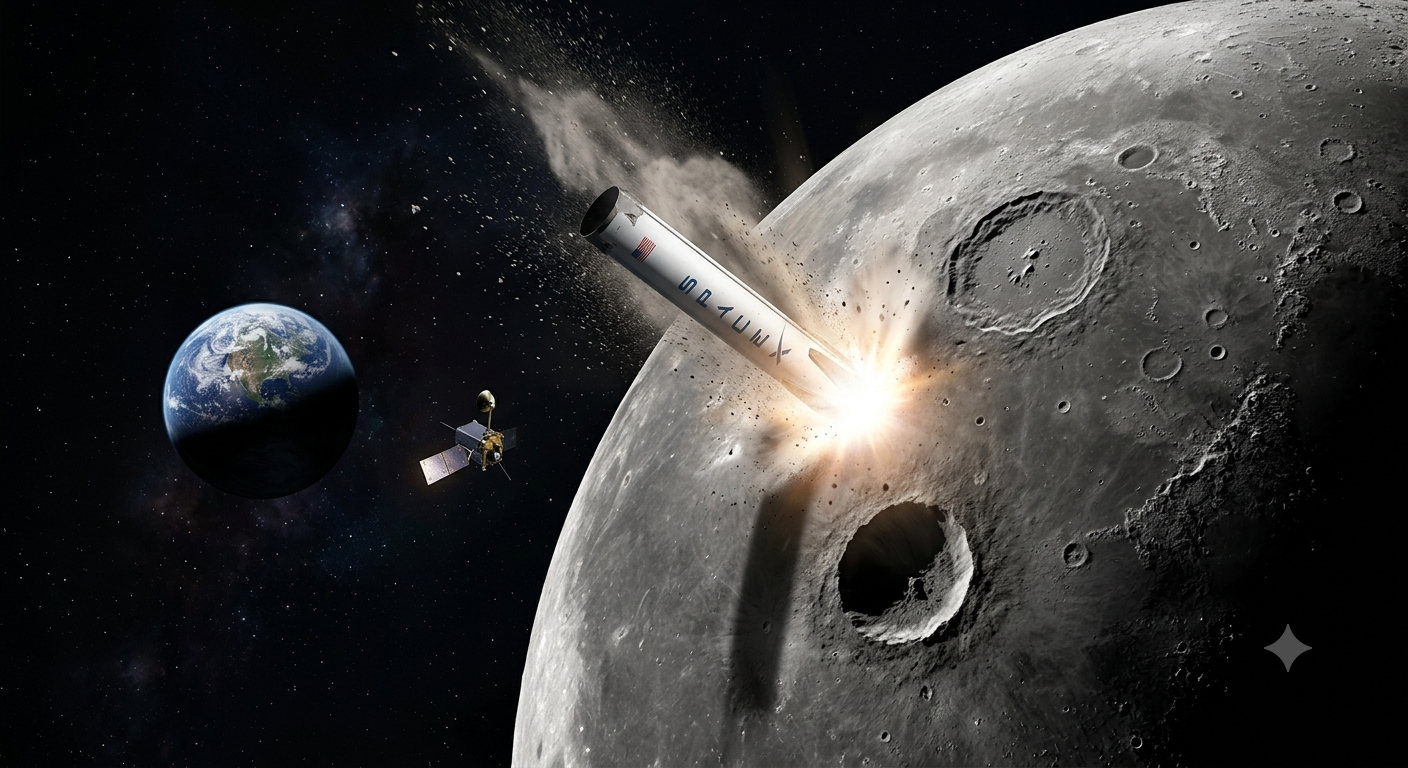
SpaceX Rocket Lunar Impact: Innovation at What Cost? A discarded four-tonne Falcon 9 second-stage rocket unexpectedly collided with the Moon on August 5, 2026. Key Details & Context The Mission: The upper stage was originally launched in January 2025 to boost two commercial lunar landers (including Firefly Aerospace's Blue Ghost) toward the Moon. Why It Didn't Re-enter: Unlike standard Earth-orbit missions where stages return to burn up in the atmosphere, this deep-space trajectory left the stage drifting. Over 18 months, gravitational interactions and solar radiation pressure gradually shifted its uncontrolled orbit onto a collision course with the lunar surface. The Crash: Traveling at roughly 5,400 mph (8,690 km/h), the rocket struck the northern hemisphere near the Einstein Crater. The impact carried energy equivalent to roughly 3 tons of TNT. Ground Effects: The collision blasted out a fresh lunar crater (estimated at ~18 meters wide and 4 meters deep) and sent a cloud of lunar dust miles into space. Impact & Scientific Importance Safety: The crash posed zero threat to Earth or active missions. Scientific Value: NASA and orbital satellites (such as the Lunar Reconnaissance Orbiter) plan to photograph the impact site to study lunar surface composition, high-speed impact physics, and space-debris risks for future missions. Space Debris Debates: While minor scientifically, the incident highlights ongoing international discussions over how private and government space programs manage leftover hardware drifting in deep space. Environmental Debates in the New Space Age Libby Jackson, Head of Space at the London Science Museum, said on the BBC that it’s highly exciting for scientists. She said this with no regard to its possible effects on Earth's environment or beyond. Is it that humanity has caused enough damage on Earth that now we need to go beyond? With SpaceX looking to take data centers into space in the future, an environmental debate is going to be the effect of the space industrial revolution, led by none other than the greatest inventor of our time, Elon Musk. Innovation is a great thing, but the question is always: at what cost?
Macro
SpaceX Rocket Lunar Impact: Innovation at What Cost?
Ad · Medium Rectangle 300×250